


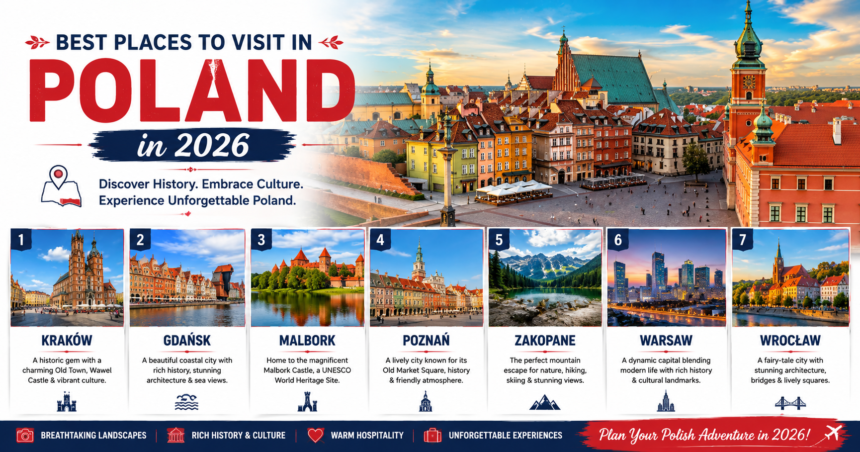
Poland has quietly become one of Europe’s most rewarding destinations, and 2026 is shaping up to be the perfect year to explore it. With its medieval old towns, dramatic mountains, pristine forests, and a coastline dotted with amber and history, this Central European gem offers something for every kind of traveler—without the crowds (or prices) of Western Europe.
Whether you’re drawn to the candlelit cobblestones of Kraków, the wild bison of Białowieża, or the sailing paradise of the Masurian Lakes, the best places to visit in Poland in 2026 span cities, countryside, and coast. This Poland travel guide walks you through the top ten destinations, when to go, what to see, and how to make your zloty stretch further. Pack your curiosity (and comfortable shoes), because Poland is ready to surprise you.
Why Poland Is a Must-Visit Destination in 2026
Poland rewards travelers in ways that few European countries can match. It blends a deep, often heartbreaking history with a forward-looking energy, all wrapped up in landscapes that range from Baltic beaches to alpine peaks.
Here’s why it deserves a spot on your 2026 itinerary:
- Excellent value for money. Compared to neighbors like Germany or the Czech Republic, Poland remains refreshingly affordable. Budget travelers can get by on around €35–45 a day, while mid-range visitors typically spend €70–95.
- Incredible variety. Few countries pack so much diversity into one trip—UNESCO-listed old towns, primeval forests, lake districts, and ski resorts are all within easy reach.
- Easy to get around. Poland’s modern train network connects major cities like Warsaw, Kraków, and Gdańsk quickly and comfortably.
- Rich, moving history. From royal castles to sobering wartime memorials, Poland offers some of the most powerful historical experiences in Europe.
- Warm hospitality and hearty food. Pierogi, żurek soup, and a thriving café culture make this a destination that feeds the soul as much as the stomach.
Top 10 Best Places to Visit in Poland in 2026
From buzzing capitals to hidden gems, these are the tourist attractions in Poland you won’t want to miss.
| Destination | Best For | Best Time to Visit | Don’t Miss |
| Warsaw | History & city life | May–September | Old Town, museums |
| Kraków | Culture & heritage | April–June, Sept–Oct | Wawel Castle, Main Square |
| Gdańsk | Coast & maritime history | June–August | Long Market, Baltic beaches |
| Wrocław | Charm & atmosphere | May–September | Market Square, dwarf statues |
| Zakopane | Mountains & skiing | Dec–Feb, June–Sept | Tatra Mountains, Krupówki |
| Poznań | Food & architecture | May–September | Old Market Square, croissants |
| Białowieża Forest | Nature & wildlife | May, July, winter | European bison, primeval forest |
| Masurian Lakes | Sailing & relaxation | June–August | Lake cruises, Mikołajki |
| Toruń | Medieval history | May–September | Gothic old town, gingerbread |
| Szczecin | Off-the-beaten-path | Late spring–early autumn | Wały Chrobrego, waterfront |
1. Warsaw
Poland’s capital is a city of remarkable resilience. Almost entirely destroyed during World War II, Warsaw rebuilt itself brick by brick—and today it pairs a meticulously reconstructed Old Town with gleaming skyscrapers and a buzzing creative scene.
- Main attractions: The UNESCO-listed Old Town (Stare Miasto), the Royal Castle, the Warsaw Uprising Museum, and the POLIN Museum of the History of Polish Jews. Warsaw is genuinely a museum lover’s heaven.
- Best time to visit: May through September, when outdoor cafés spill onto the squares and the riverside parks come alive.
- Travel tip: Many top museums offer free admission on certain weekdays—check schedules in advance to save money.
2. Kraków
If you visit just one city in Poland, make it Kraków. The former royal capital survived the war largely intact, leaving behind one of Europe’s most beautiful and atmospheric old towns.
- Main attractions: Wawel Castle, the vast Main Market Square (one of the largest medieval squares in Europe), the historic Jewish quarter of Kazimierz, and nearby day trips to Auschwitz-Birkenau and the Wieliczka Salt Mine.
- Best time to visit: April to June and September to October offer pleasant weather and thinner crowds.
- Travel tip: Book Auschwitz-Birkenau tickets well in advance, especially in summer—they sell out fast.
3. Gdańsk
Perched on the Baltic coast, Gdańsk is one of Poland’s most striking cities, with a Hanseatic old town of tall, colorful merchant houses and a fascinating maritime past.
- Main attractions: The Long Market (Długi Targ), the towering Gothic St. Mary’s Church, the Museum of the Second World War, and easy trips to the seaside resort of Sopot and the mighty Malbork Castle.
- Best time to visit: June through August, when the Baltic beaches and waterfront are at their liveliest.
- Travel tip: Hop on a train to nearby Sopot for a relaxed beach day and Europe’s longest wooden pier.
4. Wrocław
Often overlooked by first-time visitors, Wrocław is a city full of character. Built across a dozen islands connected by more than a hundred bridges, it has a relaxed, romantic feel all its own.
- Main attractions: The colorful Market Square (Rynek), Cathedral Island (Ostrów Tumski), and the city’s beloved collection of tiny bronze dwarf statues hidden throughout the streets.
- Best time to visit: May to September for warm days and outdoor festivals.
- Travel tip: Pick up a dwarf-hunting map and turn your sightseeing into a quirky treasure hunt—great fun for families.
5. Zakopane
Tucked at the foot of the Tatra Mountains, Zakopane is Poland’s premier mountain resort and the gateway to some of the country’s most spectacular scenery.
- Main attractions: Hiking and skiing in the Tatra National Park, the lively Krupówki pedestrian street, and the funicular up Gubałówka for sweeping mountain views.
- Best time to visit: December to February for skiing, or June to September for hiking and warmer weather.
- Travel tip: Sample oscypek, the region’s smoked sheep’s cheese sold at street stalls—it’s a local mountain specialty.
6. Poznań
A lively university city between Warsaw and Berlin, Poznań is known for its gorgeous Renaissance architecture and excellent food scene.
- Main attractions: The Old Market Square (Stary Rynek) with its colorful merchant houses, the famous mechanical billy goats that butt heads on the town hall clock at noon, and the St. Martin’s Croissant Museum.
- Best time to visit: May through September for the best weather and outdoor events.
- Travel tip: Don’t leave without trying a rogal świętomarciński—the city’s protected, poppy seed–filled croissant.
7. Białowieża Forest
Straddling the border with Belarus, Białowieża is one of the last remaining fragments of the primeval forest that once blanketed much of Europe. It’s a UNESCO World Heritage Site and a haven for rare wildlife.
- Main attractions: Guided walks through the strictly protected forest, the European bison reserve, and early-morning wildlife safaris in search of Europe’s largest land mammal.
- Best time to visit: Late May for lush greenery and birdlife, mid-summer for warm weather, or winter for atmospheric snow tracking.
- Travel tip: You can only enter the strictly protected core area with a licensed guide, so book ahead.
8. Masurian Lake District
In northeastern Poland, the Masurian Lake District is a watery wonderland of more than 2,000 lakes, woods, and quiet villages—a summer playground for sailors, kayakers, and anyone craving the outdoors.
- Main attractions: Sailing and kayaking across interconnected lakes, the resort towns of Mikołajki and Giżycko, and a sobering visit to the Wolf’s Lair, Hitler’s wartime headquarters.
- Best time to visit: June to August, when temperatures reach a pleasant 25–28°C and the water is warm.
- Travel tip: Rent a car—public transport is limited here, and a vehicle lets you explore the lakes at your own pace.
9. Toruń
The birthplace of astronomer Nicolaus Copernicus, Toruń boasts one of Poland’s best-preserved medieval old towns, complete with a Gothic skyline that escaped wartime destruction.
- Main attractions: The UNESCO-listed old town, the Leaning Tower, the Copernicus House, and the city’s centuries-old gingerbread tradition.
- Best time to visit: May to September for warm, comfortable sightseeing weather.
- Travel tip: Pick up a box of pierniki (traditional gingerbread)—it makes a perfect, edible souvenir.
10. Szczecin
Close to the German border in the country’s northwest, Szczecin is one of Poland’s most underrated cities—spacious, green, and refreshingly free of tourist crowds.
- Main attractions: The grand Wały Chrobrego promenade overlooking the river, the Ducal Castle, the Museum of Technology and Transport, and plenty of summer festivals.
- Best time to visit: Late spring to early autumn for waterfront strolls and outdoor events.
- Travel tip: Szczecin pairs nicely with a side trip to the Baltic resort island of Świnoujście or even a quick hop to Berlin.
Best Time to Travel to Poland
The best time to travel to Poland depends largely on what you want to see and do.
- Spring (April–June): A wonderful time to visit, with mild weather, blooming parks, and fewer tourists. Ideal for cities like Kraków and Warsaw.
- Summer (July–August): Peak season, especially for the Baltic coast and the Masurian Lakes. Expect warm weather, lively festivals, and busier attractions.
- Autumn (September–October): Crisp air, golden foliage, and thinner crowds make this a favorite for sightseeing and photography.
- Winter (December–February): Perfect for skiing in Zakopane, magical Christmas markets, and atmospheric snow-covered forests like Białowieża.
For a balance of good weather and manageable crowds, late spring and early autumn are the sweet spots for most travelers.
Budget and Travel Tips for Visitors
Poland is one of Europe’s best-value holiday destinations, but a little planning goes a long way. Here are practical tips to help your travel Poland 2026 adventure run smoothly:
- Daily budget: Budget travelers can manage on around €35–45 per day, mid-range visitors on €70–95, and luxury travelers €200 and up. A short 3-day, 2-night trip for mid-range travelers typically runs $320–550 per person.
- Currency: Poland uses the Polish złoty (PLN), not the euro. Carry some cash for smaller towns and markets, though cards are widely accepted in cities.
- Travel by train: The national rail network is efficient and affordable. Book intercity tickets in advance for the best fares.
- Eat like a local: Look for a “bar mleczny” (milk bar)—these no-frills cafeterias serve hearty Polish classics at very low prices.
- Free museum days: Many major museums offer free entry on a designated weekday. Plan around these to save.
- Learn a few phrases: A simple “dziękuję” (thank you) goes a long way with locals.
- Pack for variety: Weather can shift quickly, so layers are your friend—especially if you’re combining cities with mountains or lakes.
Frequently Asked Questions
1. Is Poland safe for tourists in 2026?
Yes. Poland is considered one of the safer countries in Europe for travelers. As with anywhere, use common sense in crowded areas and keep an eye on your belongings, but violent crime against tourists is rare.
2. How many days do I need to visit Poland?
A week lets you cover the highlights of Kraków, Warsaw, and Gdańsk comfortably. With 10 to 14 days, you can add Wrocław, Zakopane, and a nature escape like the Masurian Lakes or Białowieża Forest.
3. Do I need a visa to visit Poland?
Poland is part of the Schengen Area. Travelers from the US, UK, Canada, Australia, and the EU can visit for up to 90 days without a visa. Always check the latest entry requirements before you travel.
4. Is Poland expensive to visit?
Not at all—it’s one of the more affordable destinations in Europe. Accommodation, food, and transport all cost noticeably less than in Western European countries.
5. What is the best city to visit in Poland for first-timers?
Kraków is the top choice for first-time visitors thanks to its stunning, well-preserved old town, rich history, and proximity to major attractions like Auschwitz-Birkenau and the Wieliczka Salt Mine.
Conclusion
From the royal grandeur of Kraków to the wild silence of Białowieża Forest, the best places to visit in Poland in 2026 prove just how much this country has to offer. It’s a destination where medieval squares meet modern energy, where mountains, lakes, and coastline are all within reach, and where your travel budget stretches further than almost anywhere else in Europe.
Whether you’re planning a fast-paced city tour or a slow escape into nature, Poland delivers experiences that linger long after you’ve returned home. Start mapping out your route, pick the seasons that suit your interests, and get ready to discover one of Europe’s most rewarding holiday destinations. With so many tourist attractions in Poland waiting to be explored, 2026 might just be the year you fall in love with this remarkable corner of Central Europe.